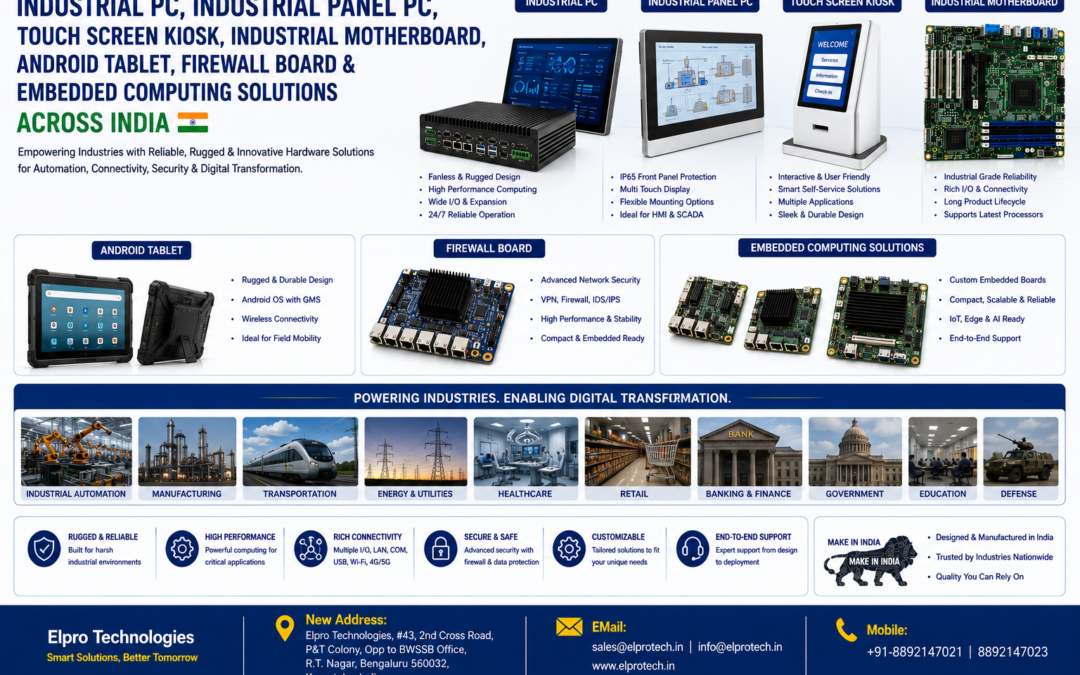
Panel PC Solutions in Bangalore: A Focus on Elpro Technologies and Local Market Trends

Panel PC Bangalore: Industrial Automation Solutions

A report indicates that manufacturing contributes approximately 17% to India’s GDP. In this landscape, industrial automation is crucial, and Panel PC Bangalore solutions are integral components. This article explores Panel PC options available in Bangalore, Karnataka, focusing on Elpro Technologies. We will delve into the significance of industrial automation and Human Machine Interface (HMI) technology, highlighting how Panel PCs enhance efficiency and identifying leading Bangalore suppliers.

Understanding Panel PC Basics in Bangalore

What are Panel PCs in Bangalore? They are integrated computer and display systems designed for industrial and commercial applications. They facilitate monitoring and control across various processes. The Panel PC Bangalore market is dynamic, supporting advancements in manufacturing, pharmaceutical production, and even food processing. Elpro Technologies offers a diverse portfolio of Panel PC models tailored to meet the specific needs of industries in Karnataka. The synergy between HMI Bangalore and Panel PCs provides a significant advantage, enabling real-time data visualization and immediate process control, leading to improved productivity and reduced operational costs.

Panel PC Bangalore: Applications in Automation

Panel PCs are vital for industrial automation in Bangalore, streamlining operations and enhancing precision in manufacturing. The demand for Panel PC Bangalore is driven by the need for real-time monitoring and control of automated systems. HMI Bangalore, facilitated by Panel PCs, enables seamless interaction between operators and machines. Elpro Technologies provides Panel PC solutions designed for diverse industrial automation applications, resulting in improved efficiency and reduced waste. As industrial automation expands, Panel PCs are playing an increasingly important role.

  • Manufacturing: Monitor and manage production lines for enhanced quality control.
  • Pharmaceuticals: Ensure precise control and safety in pharmaceutical manufacturing processes.
  • Food Processing: Optimize food processing operations for enhanced safety and efficiency.
  • Logistics: Track and manage inventory in real-time for improved supply chain management.

Market Trends and Growth Drivers

The Panel PC Bangalore market is experiencing rapid growth, fueled by increasing automation and the demand for advanced HMIs. Government initiatives promoting industrial automation and technological advancements are also driving demand for Panel PC Bangalore solutions. Elpro Technologies offers cutting-edge Panel PC units that align with evolving market demands. Features such as touch screens, wireless connectivity, and ruggedized designs are enhancing the appeal of Panel PCs. The Indian industrial automation sector is poised for substantial growth, driven by rising labor costs and the need for increased productivity.

  • Increasing Automation: The rise of automation is driving demand for Panel PCs.
  • Technological Advancements: Modern features make Panel PCs more effective.
  • Government Initiatives: Government support is boosting industrial automation.
  • Rising Labor Costs: Panel PCs help offset increasing labor expenses.

Panel PC Bangalore: Elpro Technologies – A Local Leader

When considering Panel PC Bangalore solutions, Elpro Technologies stands out as a reputable provider. They offer a comprehensive range of Panel PCs tailored to the specific needs of industries in Karnataka. Their commitment to quality, innovation, and customer satisfaction makes them a reliable partner for industrial automation projects. Elpro Technologies aims to deliver exceptional HMI Bangalore solutions that optimize operational efficiency. They understand the unique requirements of the local market and provide customized Panel PC solutions. Their comprehensive after-sales support ensures customer satisfaction. Many businesses choose their excellent Panel PC units to enhance automation.

Panel PC Bangalore: The Role of HMI

Human Machine Interface (HMI Bangalore) plays a critical role in enhancing user experience with Panel PCs. An effective HMI enables intuitive system operation, monitoring, and decision-making. Enhanced HMI features, such as clear displays and touch controls, simplify complex tasks. Elpro Technologies recognizes the importance of HMI in their Panel PC solutions, prioritizing ease of use. A well-designed HMI reduces training time and minimizes errors, enhancing safety and quality. Ultimately, an effective HMI boosts productivity and reduces downtime.

  • Intuitive Interface: Simplifies tasks and reduces the learning curve.
  • Graphical Displays: Provides clear and concise information for enhanced situational awareness.
  • Touch Screen Controls: Enables simple and intuitive operation.
  • Real-Time Data Visualization: Facilitates informed decision-making with up-to-date data.

Panel PC Bangalore: Customization and Configuration

Customization is essential for Panel PC Bangalore deployments. Every business has unique requirements, and Panel PCs should be adaptable. Elpro Technologies offers extensive customization options, allowing customers to select their preferred screen size, processor, memory, and connectivity options. This enables businesses to acquire a Panel PC that perfectly aligns with their needs. Software and HMI customization options are also available, ensuring seamless integration with existing systems. The ability to customize Panel PCs maximizes their effectiveness. The demand for custom Panel PC Bangalore solutions is increasing as businesses seek to optimize their automation investments.

Panel PC Bangalore: Ruggedized Designs

Bangalore’s industrial environments often present harsh conditions, including dust, moisture, and extreme temperatures. Panel PCs deployed in these environments must be robust and reliable. Elpro Technologies offers a range of Panel PC Bangalore models designed for durability. These units feature sealed enclosures, vibration resistance, and wide temperature operating ranges. These features protect the Panel PC and ensure reliable operation in challenging conditions. Ruggedized Panel PCs are essential for applications in mining, construction, and outdoor environments. Investing in durable Panel PC units minimizes downtime and extends equipment lifespan. The demand for ruggedized Panel PCs in harsh environments underscores the importance of robust designs.

Panel PC Bangalore: System Integration

Seamless integration with existing systems is crucial when implementing Panel PC Bangalore solutions. Panel PCs must integrate easily with diverse industrial standards and communication protocols. Elpro Technologies provides Panel PC solutions that support a wide range of interfaces, including Ethernet, serial connections, and USB. This facilitates easy integration with Programmable Logic Controllers (PLCs), sensors, and other devices. Seamless integration ensures smooth data flow, enabling real-time monitoring and control. When Panel PCs integrate effectively with existing systems, operations become streamlined and efficient. The demand for Panel PC Bangalore units with robust integration capabilities reflects the desire for simplified automation deployments.

Panel PC Bangalore: Maintenance and Support

Comprehensive maintenance and support are vital for ensuring the long-term reliability of Panel PC Bangalore deployments. Proactive maintenance minimizes downtime and extends equipment lifespan. Elpro Technologies offers a range of support services, including on-site maintenance, remote diagnostics, and software updates. Their experienced team provides prompt and effective support, ensuring uninterrupted operations. Regular maintenance ensures that Panel PCs continue to perform optimally. Comprehensive support services are an important consideration when selecting Panel PC suppliers. The demand for comprehensive support reflects the desire to maximize the return on investment in Panel PC solutions.

Final Thoughts

The Panel PC market in Bangalore is vibrant, driven by the growth of industrial automation and the demand for advanced HMI solutions. Elpro Technologies is a key player in this market, offering a diverse range of Panel PC solutions tailored to the needs of industries in Karnataka. This article has highlighted the importance of customization, ruggedization, integration, and support in ensuring the effectiveness of Panel PC deployments. As businesses in Bangalore increasingly embrace automation, the demand for high-quality Panel PC solutions will continue to grow.

Choosing the Right Industrial Touch Panel Computer for Your Factory Automation Needs in India

Industrial Touch Panel Computer India: A Comprehensive Guide

A recent report forecasts India’s industrial automation market to potentially reach $18.4 billion by 2027. Increasingly, factories are adopting advanced technologies, with Industrial Touch Panel Computer India solutions leading the charge. This guide provides a comprehensive overview to help you select the ideal Industrial Touch Panel Computer for your needs. We’ll delve into essential components, benefits, and integration strategies with systems like Touch Screen PCs, PLCs, and SCADA.

Understanding the Significance of Industrial Touch Panel Computers in India

An Industrial Touch Panel Computer is more than just a display screen; it’s a critical tool for machine control and data acquisition in demanding industrial environments. Unlike standard computers, these rugged devices are built to withstand harsh conditions typical of factories. They enable real-time monitoring, control, and data capture, leading to increased efficiency, reduced downtime, and improved overall productivity.

Here’s why investing in Industrial Touch Panel Computers is a smart move:

  • Enhanced Durability: Resistant to extreme temperatures, shocks, dust, and moisture, ensuring reliable operation in challenging environments.
  • Improved Efficiency: Facilitates real-time monitoring and informed decision-making.
  • Reduced Downtime: Enables proactive problem detection and minimizes disruptions.
  • Increased Productivity: Streamlines operations and automates processes, leading to higher output.
  • Better Data Management: Simplifies data collection, storage, and analysis for continuous improvement.

As factories embrace digitalization and interconnected systems, Industrial Touch Panel Computers serve as crucial data gateways, seamlessly integrating with PLC and SCADA systems.

Key Factors to Consider When Choosing an Industrial Touch Panel Computer in India

Selecting the right Industrial Touch Panel Computer India requires careful consideration of your specific needs and operating environment. Factors such as temperature, power requirements, connectivity options, and screen size all play a crucial role in ensuring optimal performance and compatibility.

  • Environmental Factors: Assess temperature extremes, humidity levels, dust exposure, and potential exposure to corrosive substances. Choose a computer designed to withstand these conditions.
  • Processing Power: Select a computer with sufficient processing power to handle data processing, calculations, and graphical displays.
  • Connectivity Options: Ensure compatibility with your existing infrastructure, including PLCs, SCADA systems, and other devices. Look for essential ports such as Ethernet, USB, serial ports, and Wi-Fi.
  • Display Size and Resolution: Choose a screen size and resolution that provides clear visibility and comfortable viewing, considering viewing distance and data density.
  • Touch Technology: Evaluate different touch technologies (resistive, capacitive, infrared) based on accuracy, responsiveness, and durability requirements.

The Indian industrial automation market offers a wide array of Industrial Touch Panel Computer India options. Thoroughly evaluate your needs and carefully compare available choices to make an informed decision.

Integrating Industrial Touch Panel Computers with PLC Systems

PLCs (Programmable Logic Controllers) and Industrial Touch Panel Computers work synergistically in factory automation. PLCs control machines, while Industrial Touch Panel Computers provide a user interface for monitoring and control. Seamless integration between these systems is essential for efficient operation.

Key considerations for integrating Industrial Touch Panel Computers with PLCs include:

  • Communication Protocols: Ensure compatibility between the computer and PLC using standard protocols such as Modbus, Profibus, Ethernet/IP, and OPC UA.
  • HMI Software: Choose Human Machine Interface (HMI) software that facilitates intuitive screen design, data linking, and control functionality.
  • Data Mapping: Establish clear data mapping between the PLC and the computer display to enable real-time monitoring and control.
  • Alarm Management: Implement alarm systems to alert operators to potential issues and facilitate timely intervention.
  • Security: Protect both the PLC and the computer from unauthorized access and cyber threats.

A well-integrated Industrial Touch Panel Computer and PLC system enhances operational visibility, enables informed decision-making, and promotes rapid response to changing conditions.

Leveraging Industrial Touch Panel Computers with SCADA Systems

SCADA (Supervisory Control and Data Acquisition) systems oversee and control large-scale industrial processes. An Industrial Touch Panel Computer can extend the reach of SCADA systems by providing local monitoring and control capabilities. The computer displays data, alarms, and controls, empowering operators to manage local operations effectively.

Benefits of integrating an Industrial Touch Panel Computer with SCADA include:

  • Local Control: Maintains operational control even if the main SCADA system is unavailable.
  • Real-Time Monitoring: Provides immediate insights into process status and facilitates rapid response to deviations.
  • Improved Visualization: Presents data in a user-friendly graphical format for enhanced understanding.
  • Data Logging: Provides a local data backup for redundancy and historical analysis.
  • Remote Access: Enables remote monitoring and control for increased flexibility.

When integrating an Industrial Touch Panel Computer with SCADA, ensure seamless communication and compatibility between hardware, software, and communication protocols. A well-designed system provides operators with the information they need to make informed decisions and optimize plant performance. The Touch Screen PC handles local control and SCADA runs the big show.

Touch Screen PC Technology in Industrial Touch Panel Computers

The touch screen is a critical component of an Industrial Touch Panel Computer. Its performance and usability directly impact operator efficiency. Common touch screen technologies include resistive, capacitive, and infrared, each with its own advantages and disadvantages.

  • Resistive Touchscreens: Cost-effective and durable, activated by pressure, and resistant to contaminants. However, they offer lower clarity and responsiveness compared to other technologies.
  • Capacitive Touchscreens: Offer superior clarity and responsiveness, detecting touch through electrical capacitance. However, they are more susceptible to damage and interference from contaminants.
  • Infrared Touchscreens: Utilize infrared beams to detect touch, providing excellent clarity, responsiveness, and resistance to contaminants. However, they are generally more expensive.

Factors to consider when selecting a touch screen include:

  • Accuracy: The precision with which the screen registers touch input.
  • Responsiveness: The speed at which the screen reacts to touch input.
  • Durability: The screen’s resistance to damage from impacts, scratches, and environmental factors.
  • Cost: The overall cost of the touch screen technology.

The right touch screen technology significantly enhances the usability and effectiveness of the Industrial Touch Panel Computer. These computers have revolutionized factories, making processes simpler and faster.

The Role of Industrial Touch Panel Computers in Predictive Maintenance

Predictive maintenance involves anticipating potential equipment failures and addressing them proactively. An Industrial Touch Panel Computer can play a vital role in predictive maintenance by collecting data from sensors and analyzing it to identify potential problems before they lead to downtime. This reduces disruptions and saves money. The Industrial Touch Panel Computer is the brain, grabbing data and showing how things stand.

How to leverage an Industrial Touch Panel Computer for predictive maintenance:

  • Data Collection: Gather data from sensors monitoring parameters such as temperature, vibration, pressure, and power consumption.
  • Data Analysis: Analyze the collected data to identify patterns and anomalies that may indicate impending failures.
  • Visualization: Present the data in a clear and intuitive format to facilitate rapid problem identification.
  • Alarming: Set up alarms to alert personnel when critical parameters exceed predefined thresholds.
  • Integration: Integrate the Industrial Touch Panel Computer with other systems for comprehensive monitoring and control.

By utilizing an Industrial Touch Panel Computer for predictive maintenance, factories can prevent equipment failures, minimize downtime, and reduce maintenance costs. The Industrial Touch Panel Computer is key for factories. It keeps things in shape. Linking with PLC and SCADA makes it even better. You see all the machine details.

Cost Analysis: Investing in Industrial Touch Panel Computers

Before investing in an Industrial Touch Panel Computer, it’s essential to conduct a thorough cost analysis to ensure a positive return on investment. While the initial cost may seem significant, the long-term benefits of increased efficiency and reduced downtime often outweigh the upfront expense. The Industrial Touch Panel Computer? Think of it as an investment. It makes the factory better.

Factors to consider in your cost analysis:

  • Initial Cost: The cost of the computer, software, and installation.
  • Maintenance Costs: Ongoing expenses for repairs, replacement parts, and software updates.
  • Downtime Costs: The financial impact of production disruptions due to equipment failures.
  • Productivity Gains: The increase in output resulting from improved efficiency and automation.
  • Energy Savings: Potential reductions in energy consumption.

Calculate the payback period to determine the time required to recoup your investment. By carefully evaluating the costs and benefits, you can make an informed decision about whether an Industrial Touch Panel Computer is a worthwhile investment for your factory. Adding Industrial Touch Panel Computers to factories can save big and make things much better. The Touch Screen PC is easy to use. It helps you watch and control things.

Future Trends in Industrial Touch Panel Computer Technology

Industrial Touch Panel Computers are constantly evolving, driven by advancements in technology and changing industry needs. Key trends shaping the future of these devices include:

  • Increased Processing Power: More powerful processors enable faster data processing and more complex applications.
  • Improved Display Technology: Brighter, sharper, and more energy-efficient displays enhance visibility and reduce power consumption.
  • Enhanced Touch Technology: More accurate, responsive, and durable touch screens improve user experience.
  • Wireless Connectivity: Seamless wireless connectivity enables easier integration with networks and other devices.
  • Cloud Integration: Cloud integration facilitates data sharing and remote access.
  • Artificial Intelligence (AI): AI-powered features enable predictive maintenance and automated control.

These advancements will further enhance the capabilities of Industrial Touch Panel Computers, making them even more valuable for optimizing factory operations. Industrial Touch Panel Computers will matter even more as things change. Knowing these trends helps you make smart choices. Linking with PLC and SCADA will keep getting better. Factories will run easier.

Case Studies: Successful Implementation of Industrial Touch Panel Computers

Examining real-world examples of Industrial Touch Panel Computer implementations can provide valuable insights into their potential benefits. These case studies demonstrate how Industrial Touch Panel Computers can improve efficiency, reduce downtime, and increase productivity. The Industrial Touch Panel Computer has changed factories for the better.

Examples of successful implementations:

  • Automotive Manufacturing: An automotive factory used Industrial Touch Panel Computers to monitor the assembly line, resulting in a 20% increase in production and a 15% reduction in downtime.
  • Food and Beverage Processing: A food processing plant used Industrial Touch Panel Computers to monitor production processes, leading to a 10% reduction in energy consumption and a 5% improvement in product quality.
  • Pharmaceutical Manufacturing: A pharmaceutical company used Industrial Touch Panel Computers to monitor drug manufacturing processes, resulting in a 12% reduction in costs and an 8% improvement in regulatory compliance.

These case studies illustrate the transformative potential of Industrial Touch Panel Computers. By learning from these examples, factories can make informed decisions about implementing these technologies. Linking with PLC and SCADA often happens in these cases. This shows how important it is to work as a team. The Touch Screen PC makes it easy to watch and control things.

Final Thoughts

Selecting the right Industrial Touch Panel Computer is a critical decision that can significantly impact your factory’s performance. By carefully considering the factors outlined in this guide, including environmental conditions, power requirements, touch screen technology, and integration with PLC and SCADA systems, you can choose a computer that effectively addresses your specific needs. The Industrial Touch Panel Computer is important. It keeps things running, handles data, and makes things better. Buying the right Industrial Touch Panel Computer? It is like buying a better future for your factory.

Fanless Panel PCs: Advantages and Applications in Harsh Industrial Environments in India

Fanless Panel PC India: The Future of Industrial Computing

A 2023 report by Grand View Research projects the industrial PC market to reach $5.49 billion by 2030, fueled by increased automation. This article delves into the value of Fanless Panel PC India in demanding industrial environments. We’ll explore how different Industrial PC solutions, including Fanless Computer and Rugged PC options, provide robust support, especially as a reliable Dustproof PC. Why are fanless panel PCs becoming so crucial for Indian industries? Let’s find out.

Why Choose a Fanless Panel PC in India?

Fanless Panel PC India are vital for modern, automated workshops. These computers operate without traditional spinning fans, making them ideal for environments with dust, debris, and extreme temperatures. The absence of fans minimizes breakdowns and keeps the internal components clean, extending their lifespan and improving overall efficiency. You’ll commonly find these Industrial PC units in factories, oil refineries, and transportation systems, where reliability and consistent performance are paramount. The Fanless Computer design ensures cost-effective maintenance and high uptime, crucial for maximizing productivity. A Rugged PC configuration enhances their suitability for harsh conditions, while a Dustproof PC design safeguards internal parts from particulate contamination.

The Benefits of Fanless Panel PCs in India’s Harsh Environments

Why should you choose a Fanless Panel PC India? They offer numerous advantages, particularly in challenging industrial settings. Enhanced durability is a significant benefit. Standard PCs with fans are prone to failure due to dust accumulation and component wear. Fanless Computer systems overcome this issue, ensuring continuous operation. Control Engineering reports that eliminating fans can significantly reduce downtime and repair expenses. These Industrial PC units often withstand extreme heat, cold, vibrations, and impacts, making them suitable for demanding applications. A Rugged PC design ensures they can endure rough handling, and a Dustproof PC casing prevents particle damage. This increased durability translates to improved performance and lower operational costs.

  • Reduced downtime due to fan-related issues
  • Lower maintenance costs
  • Improved resistance to dust, debris, and extreme temperatures
  • More robust and reliable designs

Diverse Applications of Fanless Panel PC India

Fanless Panel PC India have a wide range of applications across various industries. In manufacturing plants, these computers control machinery, monitor production processes, and manage inventory. Their robust construction allows them to withstand the demanding conditions of factory floors. Industrial PC units also monitor traffic flow, manage logistics, and display information to personnel in transportation sectors. In the oil and gas industry, Fanless Computer systems remotely monitor equipment, even in hazardous locations. Automation.com highlights the growing demand for industrial panel PCs, which help improve efficiency and reduce costs across diverse sectors. Rugged PC models are ideal for outdoor applications, while Dustproof PC designs are essential in environments with airborne particles.

  • Manufacturing: controlling machinery and monitoring production lines
  • Transportation: tracking traffic and managing shipments
  • Oil and Gas: remotely monitoring and controlling equipment
  • Food and Beverage: maintaining clean and efficient processes

Key Features to Consider When Buying a Fanless Panel PC India

Selecting the right Fanless Panel PC India requires careful evaluation. Processing power is crucial for handling demanding tasks and calculations. The screen type and size should match your specific needs, ranging from small touch displays to large, high-resolution screens. Consider the available connection options; Ethernet, USB, and serial ports are essential for connecting peripherals. Moxa emphasizes that heat tolerance is critical for reliable performance in harsh environments. The Industrial PC should also have sufficient storage capacity for programs and data. A Rugged PC should undergo rigorous testing for vibration, shock, and temperature resistance, while a Dustproof PC must prevent dust and moisture ingress. The processor type is also an important consideration for software compatibility and performance.

  • Processing Power: sufficient capacity for demanding applications
  • Screen Type and Size: appropriate for the intended use
  • Connection Options: Ethernet, USB, serial ports, etc.
  • Operating Temperature Range: suitable for the environment
  • Storage Capacity: ample space for programs and data
  • Compliance with Standards: meets relevant industry standards
  • Processor: compatible with required software

The Importance of Ruggedization in Fanless Panel PC India

Ruggedization is extremely important for Fanless Panel PC India, enabling them to withstand harsh industrial environments. A Rugged PC can endure impacts, vibrations, extreme temperatures, and moisture. This involves using robust materials like stainless steel and incorporating features such as sealed enclosures and vibration-dampening mounts. OnLogic notes that rugged computers undergo rigorous testing to meet standards like MIL-STD-810G, which defines testing procedures for vibration, shock, and extreme temperatures. A Dustproof PC design is also crucial, preventing dust and debris from entering the system through sealed cases and filters. The required level of ruggedization depends on the specific application and environment. In very harsh conditions, a fully ruggedized Industrial PC is essential for maintaining continuous and reliable operation. Adding rugged features to a Fanless Computer improves its resilience and reduces the likelihood of failure.

  • Vibration and Shock Resistance: ability to withstand impacts
  • Temperature Resistance: operation in extreme temperatures
  • Moisture Resistance: protection from humidity and liquids
  • Sealed Enclosures: prevention of debris entry
  • Compliance with Standards: adherence to MIL-STD-810G or similar

Implementing Fanless Panel PC India for Enhanced Productivity

Proper implementation of Fanless Panel PC India can significantly boost industrial productivity by providing reliable and durable computing solutions that reduce downtime and maintain smooth operations. Industrial PC units can be seamlessly integrated with existing systems to streamline workflows and improve efficiency. Advantech reports that the use of industrial panel PCs can improve output and reduce costs. These systems enable real-time monitoring and control of processes, empowering workers to make informed decisions and respond quickly to changes. A Rugged PC configuration ensures it can withstand demanding conditions, while a Dustproof PC design prevents dust ingress. Furthermore, many Fanless Computer setups can be monitored and managed remotely, reducing the need for on-site personnel.

  • Seamless Integration with Existing Systems: streamlined workflows
  • Real-Time Monitoring and Control: informed decision-making
  • Remote Management Capabilities: reduced on-site personnel
  • Improved Data Accuracy: better decision making
  • Reduced Downtime: continuous operations

Maintenance and Longevity of Fanless Panel PC India

A key advantage of Fanless Panel PC India is their minimal maintenance requirements and extended lifespan. The absence of fans eliminates a common point of failure, reducing the need for repairs and replacements. Industrial PC units are designed to operate reliably for years, even in harsh environments. Axiomtek reports that industrial PCs generally last longer than standard computers. Regular cleaning and inspection can further extend their lifespan. A Rugged PC build ensures they can withstand harsh conditions, while a Dustproof PC enclosure prevents dust entry. Many Fanless Computer setups are designed for easy component replacement, which further extends their lifespan. Proper maintenance ensures they will operate optimally for years to come.

  • Reduced Maintenance: fewer repairs and replacements
  • Extended Lifespan: years of reliable operation
  • Regular Cleaning and Inspection: proactive maintenance
  • Easy Component Replacement: prolonged lifespan
  • Long-Term Cost Savings: reduced total cost of ownership

Future Trends in Fanless Panel PC India Technology

The technology powering Fanless Panel PC India is continuously evolving, with several key trends shaping the future of these systems. One trend is the use of more powerful and energy-efficient processors, enabling computers to handle complex tasks while consuming less power. Industrial PC units are also becoming smaller and lighter, making them easier to integrate into various applications. Research and Markets indicates a rapidly increasing demand for smaller, more efficient industrial PCs. Another trend is improved connectivity, such as 5G and Wi-Fi 6, providing faster and more reliable data transfer. Rugged PC designs are also being enhanced to better withstand extreme temperatures, vibrations, and shocks. The integration of artificial intelligence and machine learning capabilities will also drive innovation. The use of Dustproof PC designs will likely become even more prevalent as industries strive for cleaner and more efficient operations. The Fanless Computer market will continue to see improvements in thermal management and power efficiency.

  • More Powerful Processors: enhanced performance
  • Smaller and Lighter Designs: easier integration
  • Improved Connectivity: faster data transfer
  • Enhanced Ruggedization: greater durability
  • Integration of AI and Machine Learning: advanced capabilities

Key Takeaways on Fanless Panel PC India

Fanless Panel PC India offer significant advantages to various industries, providing reliable, durable, and efficient computing solutions. Their robust construction and resistance to dust and extreme temperatures make them suitable for demanding applications in diverse sectors. Selecting the right system and implementing it properly helps industries improve productivity, reduce downtime, and optimize operations. As technology continues to advance, Fanless Computer setups will play an increasingly important role in driving automation and innovation across industries. The use of Rugged PC and Dustproof PC designs will remain crucial for ensuring reliable performance in harsh environments. Investing in a quality Industrial PC yields long-term benefits.

Understanding HMI (Human Machine Interface) and its Role in Indian Industries

HMI India: Revolutionizing Industries with Human Machine Interfaces

According to a 2023 Mordor Intelligence report, the Human Machine Interface (HMI) market in India is poised for significant growth, projecting gains exceeding 10%. This article explores the pivotal role of HMI technology in Indian industries, examining its applications, advantages, and impact on driving efficiency and innovation. We’ll also delve into emerging trends shaping HMI India and its contribution to the country’s industrial advancement. Discover how Human Machine Interface technology seamlessly integrates with existing infrastructure to optimize operations.

Understanding Human Machine Interfaces in India

A Human Machine Interface (HMI) serves as the crucial bridge between humans and machines. In the context of HMI India, it encompasses a diverse range of hardware and software solutions designed to facilitate seamless communication in industrial settings. These interfaces empower operators to monitor, control, and interact with machinery, leading to enhanced safety, improved efficiency, and streamlined processes. The advancement of Industrial Automation is intrinsically linked to the evolution of sophisticated HMIs.

The primary function of a Human Machine Interface is to translate complex data into easily understandable information. This involves displaying critical parameters such as temperature, pressure, speed, and machine status on intuitive screens, enabling operators to make informed decisions and optimize performance. Integrating Human Machine Interface solutions with control systems provides a centralized platform for monitoring and managing complex industrial operations.

  • Clear Visualization: HMIs offer clear and concise displays, enabling operators to quickly grasp key information.
  • Intuitive Control: HMIs provide user-friendly interfaces for initiating, halting, and adjusting processes.
  • Real-time Monitoring: HMIs deliver up-to-the-minute status updates and performance metrics.
  • Rapid Troubleshooting: HMIs facilitate swift identification and resolution of issues.

The Significance of HMI India in Industrial Automation

Amidst rapid industrial transformation across India, Industrial Automation is a key driver of progress. Human Machine Interface technology is integral to this evolution, offering a streamlined approach to managing intricate systems. HMIs enable Indian industries to boost productivity, minimize downtime, and enhance overall efficiency. Selecting the right HMI India solution is paramount for sectors such as manufacturing, oil and gas, pharmaceuticals, and power generation, where precision and reliability are critical.

The impact of Human Machine Interface technology extends beyond mere monitoring and control. HMIs facilitate data collection and analysis, providing valuable insights into operational performance. This data-driven approach enables continuous improvement, identifies areas for optimization, and even predicts potential issues. Furthermore, Human Machine Interface tools seamlessly integrate with other industrial systems, such as planning and manufacturing platforms, creating a unified operational ecosystem. The synergy between control systems and advanced HMIs is reshaping industrial processes.

  • Enhanced Productivity: HMIs enable operators to manage operations swiftly and efficiently, leading to increased output.
  • Reduced Downtime: HMIs facilitate rapid problem identification and resolution, minimizing disruptions.
  • Increased Efficiency: HMIs provide real-time data and control, optimizing performance.
  • Informed Decision-Making: HMIs provide data-driven insights to support strategic choices.

HMI India and Industry 4.0 Advancement

The fourth industrial revolution, characterized by digitalization, the Internet of Things (IoT), cloud computing, and smart systems, is transforming manufacturing processes. Human Machine Interface technology is the vital link, enabling seamless interaction with these advanced digital networks. For HMI India, this translates to developing user-friendly HMIs that are compatible with diverse digital platforms and data streams. The integration of Human Machine Interface with control systems is crucial in this transition.

One notable trend in HMI India is the rise of mobile HMIs. These solutions empower operators to monitor and manage industrial processes remotely using smartphones and tablets, enhancing flexibility and responsiveness. The integration of augmented reality (AR) into HMIs is also gaining traction, overlaying digital information onto the real-world view to provide enhanced clarity and context. Industrial insights are driving new Human Machine Interface designs.

  • Mobile HMIs: Enable remote factory access and management via mobile devices.
  • AR-Enhanced HMIs: Integrate computer-generated information into the user interface.
  • Cloud-Based HMIs: Centralize data in the cloud for easy access and scalability.
  • Intelligent HMIs: Incorporate analytics to provide valuable insights.

Key Attributes of Modern HMI Systems in India

Modern Human Machine Interface (HMI) systems in India are engineered to withstand the rigors of industrial environments. They boast advanced features that enhance usability, performance, and connectivity. HMI India aims to provide operators with intuitive tools for managing complex operations, facilitating informed decisions, and achieving superior results. Integration with control systems enables centralized monitoring and management.

A key characteristic of contemporary HMIs is their ability to provide real-time data visualization, displaying parameters like temperature, pressure, and speed in an easily digestible format. Alarm systems alert operators to anomalies, enabling prompt corrective action. Trend analysis capabilities help identify patterns and predict potential issues. Multilingual support ensures accessibility across diverse workforces. These advancements are driven by innovations in industrial technology and are increasingly vital in modern factories.

  • Real-time Data Visualization: Clear graphical representations of process variables.
  • Alarm Management: Notifications for abnormal conditions.
  • Trend Analysis: Identification of patterns and prediction of issues.
  • Multilingual Support: Accessibility for diverse workforces.
  • Remote Access: Monitoring and control from any location.

SCADA’s Role in Boosting HMI Performance in India

Supervisory Control and Data Acquisition (SCADA) systems significantly enhance the functionality of Human Machine Interface (HMI) systems in India. They provide a centralized platform for monitoring and controlling large-scale industrial operations. SCADA systems enable HMIs to gather data from multiple sources, providing operators with a comprehensive view of the entire operation. This facilitates faster problem identification and resolution. The synergistic relationship between SCADA and Human Machine Interface is essential for optimizing industrial processes in India. The adoption of innovative industrial technologies further strengthens this synergy.

SCADA systems offer more than just data acquisition. They provide alarm management, historical data logging, and reporting capabilities, further empowering Human Machine Interface systems. Alarm prioritization ensures that operators address the most critical issues first. Historical data logging enables trend analysis and performance evaluation. Reporting capabilities provide valuable insights into operational efficiency. The evolution of HMI India is closely tied to advancements in SCADA technology.

  • Centralized Monitoring and Control: Manage large-scale operations from a single location.
  • Alarm Prioritization: Focus on the most critical issues.
  • Historical Data Logging: Track performance over time.
  • Reporting Capabilities: Generate insights into operational efficiency.
  • Remote Access: Monitor and control systems from anywhere.

Challenges and Opportunities for HMI India’s Growth

The HMI India market faces both challenges and opportunities as it expands. A key concern is ensuring ease of use and security. With increasing connectivity, the risk of cyberattacks rises. Human Machine Interface systems must incorporate robust security measures, including strong authentication protocols and data encryption. Secure integration with control systems is essential. These security concerns are paramount in modern industrial environments and require constant vigilance.

A significant opportunity for HMI India lies in the growing demand for mobile HMIs. As workforces become more mobile, the ability to monitor and control operations remotely is highly valued. Mobile HMIs offer increased flexibility and enable faster response times. Another opportunity is the adoption of cloud-based HMIs, which provide access to industrial data from anywhere. The integration of artificial intelligence (AI) into HMIs offers the potential to provide operators with intelligent insights. India is well-positioned to capitalize on the growth of the Human Machine Interface market.

  • Cybersecurity: Protect HMIs from cyber threats.
  • Mobile HMIs: Empower remote workforces.
  • Cloud-Based HMIs: Enable easy access and scalability.
  • AI-Powered HMIs: Provide intelligent insights.
  • Skills Gap: Address the shortage of skilled HMI professionals.

Future Trends in Human Machine Interface Technology for Indian Industries

The future of Human Machine Interface (HMI) technology in India will be shaped by several factors, including the adoption of advanced manufacturing techniques, emerging technologies, and the demand for user-friendly, intelligent solutions. HMI India will witness increased adoption of augmented reality (AR), virtual reality (VR), and artificial intelligence (AI). The way Human Machine Interface integrates with control systems will also evolve, empowering operators with greater control over industrial processes.

The integration of augmented reality (AR) into HMIs will overlay digital information onto the operator’s view, providing enhanced context and clarity. Virtual reality (VR) environments will allow operators to simulate and train for complex scenarios. AI-powered HMIs will analyze data and provide operators with intelligent recommendations for optimizing performance. The HMI India market is expected to grow significantly due to these advancements.

  • AR-Enhanced HMIs: Overlay digital data onto the user’s view.
  • VR-Based HMIs: Provide immersive virtual environments.
  • AI-Powered HMIs: Analyze data and provide intelligent recommendations.
  • Gesture Control: Enable hands-free operation of HMIs.
  • Voice Control: Allow operators to control HMIs with voice commands.

The Impact of HMI on Various Sectors in India

Human Machine Interface (HMI) technology is transforming various sectors in India, enhancing efficiency, safety, and productivity. From manufacturing to oil and gas, pharmaceuticals to power generation, HMIs are streamlining industrial operations. HMI India solutions are tailored to meet the specific needs of each industry. The key is providing operators with an intuitive interface for managing complex systems. Integration with control systems is crucial. Modern industries rely on HMIs for optimal performance. New industrial technologies require advanced HMIs.

In manufacturing, HMIs monitor and control production lines, ensuring consistent quality. In the oil and gas sector, HMIs monitor pipelines and facilities, preventing accidents and ensuring safe operations. In pharmaceuticals, HMIs control drug manufacturing processes, ensuring product purity. In power generation, HMIs manage power plants, maintaining grid stability. HMI India is transforming these sectors.

  • Manufacturing: Monitor and control production lines.
  • Oil and Gas: Monitor pipelines and facilities.
  • Pharmaceuticals: Control drug manufacturing processes.
  • Power Generation: Manage power plants.
  • Water Treatment: Monitor water treatment facilities.

Challenges in Implementing HMI Solutions in India

Implementing Human Machine Interface (HMI) solutions in India presents several challenges, including technological, human, and financial obstacles. Overcoming these challenges is essential to unlocking the full potential of HMI India. Integration with legacy control systems can be complex. Modern industries must address these challenges. New industrial technologies require careful implementation planning.

One challenge is the shortage of skilled HMI professionals in India. There are too few qualified individuals to design, implement, and maintain HMIs. This can hinder the growth of HMI India. The high cost of HMIs can also be a barrier to adoption. Smaller organizations may lack the resources to invest in HMI technology. Cybersecurity concerns add to the complexity and cost.

  • Skills Gap: Shortage of skilled HMI professionals.
  • High Costs: HMIs can be expensive to purchase and implement.
  • Cybersecurity: Protecting HMIs from cyber threats.
  • Integration with Legacy Systems: Compatibility with older systems.
  • Cultural Resistance: Reluctance to adopt new technologies.

Final Thoughts

Human Machine Interface technology is revolutionizing industries in India, enhancing efficiency, safety, and productivity. As industries modernize and expand, HMIs will become increasingly essential. HMIs provide operators with an intuitive interface for managing complex systems. They empower Indian industries to compete on the global stage. Integration of HMIs with control systems is key. While challenges exist, HMI India also presents significant opportunities. By investing in workforce training, cybersecurity measures, and technological innovation, India can fully leverage the benefits of HMIs and become a leader in industrial automation.

The Ultimate Guide to Panel PCs in India: Industrial Touch Panel Computers & HMI Solutions

Panel PC India: Your Guide to Industrial Computing Solutions

A Statista report projects the Indian IoT market to reach $15 billion, highlighting the critical need for reliable computing in industrial settings. This guide explores Panel PC India solutions, focusing on industrial touch panel computers and HMI systems. We’ll cover their purpose, unique features, and key considerations for selecting the right one for your factory, helping you navigate the Indian market for robust industrial computing.

Understanding Panel PCs in India

What are Panel PCs in India? They’re integrated, all-in-one computer systems combining a display, touch interface, and processing unit. These industrial touch panel computers are designed for durability and reliability in demanding environments. With increasing automation and IoT adoption across manufacturing and logistics, the demand for dependable panel PC India options is growing.

  • Integrated Design: Combines screen, touch input, and computer in a single unit.
  • Rugged Construction: Built to withstand harsh industrial conditions.
  • Versatile Applications: Suitable for HMIs, data acquisition, and process control.

The Indian market for industrial computers is seeing increased adoption of panel PCs as factories seek streamlined and reliable ways for human-machine interaction. These systems enable operators to monitor and control processes, leading to improved efficiency and reduced downtime. The intuitive industrial touch panel interface enhances usability and simplifies operations.

Key Features of Industrial Touch Panel Computers

Industrial touch panel computers are specifically engineered for optimal performance and durability in challenging factory environments. Their specialized design distinguishes them from standard consumer-grade computers, making them ideal for critical applications requiring continuous operation and resistance to extreme temperatures, humidity, and vibration. The panel PC India market offers a diverse range of options, each tailored to meet specific industrial requirements.

  • Ruggedness: Designed to withstand extreme temperatures, humidity, and vibration.
  • Touch Screen Technology: Utilizes various touch technologies (resistive, capacitive, infrared) for accurate and reliable input.
  • Fanless Design: Minimizes noise and dust accumulation, enhancing reliability.
  • Wide Operating Temperature: Operates reliably in temperatures ranging from -20°C to 60°C.
  • IP Rating: Offers protection against dust and water ingress, typically IP65 or higher.
  • Long Lifespan: Designed for extended use with continuous support, ensuring long-term reliability.

These inherent features make industrial touch panel computers ideally suited for demanding environments such as factories, oil fields, and transportation systems. The panel PC India market is focused on providing solutions that meet these stringent requirements, enabling factories to enhance automation and improve overall performance.

HMI Solutions with Panel PCs

HMI solutions are essential for modern automated factories, providing operators with a user-friendly interface for interacting with machines and processes. Panel PCs serve as a robust platform for HMI solutions, offering the necessary processing power, display capabilities, and connectivity options. Integrating HMI solutions with panel PC India devices enables real-time monitoring, control, and data acquisition, optimizing workflows and facilitating informed decision-making.

  • Real-Time Monitoring: Provides up-to-the-minute data from machines and processes.
  • Process Control: Allows operators to adjust settings and maintain processes on schedule.
  • Data Acquisition: Collects data for subsequent analysis and reporting.
  • Alarm Management: Alerts operators to potential issues and anomalies.
  • Remote Access: Enables remote monitoring and control of processes via a network.

The panel PC India market is experiencing significant demand for HMI solutions tailored to specific factory needs. These solutions often include pre-built applications and customizable interfaces, accelerating deployment and streamlining operations. The use of industrial computers as HMI solutions is becoming increasingly prevalent, particularly in industries such as pharmaceuticals, food and beverage, and automotive.

Applications Across Industries

Panel PCs find application in a wide range of industries, each leveraging the unique capabilities of these industrial computers to enhance efficiency and productivity. The panel PC India market offers a diverse selection of options, from basic machine control to advanced data analytics and visualization. Here are some key applications of panel PCs across various sectors:

  • Manufacturing: Machine control, process monitoring, and quality assurance.
  • Food and Beverage: Production line automation, recipe management, and hygiene monitoring.
  • Pharmaceuticals: Batch processing, data logging, and compliance tracking.
  • Oil and Gas: Control room applications, remote site monitoring, and pipeline management.
  • Transportation: Integration into vehicle systems, ticketing kiosks, and information displays.
  • Healthcare: Medical device interfaces, patient monitoring systems, and electronic health record keeping.
  • Retail: Point-of-sale systems, self-service kiosks, and digital signage.

The popularity of panel PC India stems from their robustness, reliability, and ease of use. These industrial touch panel computers seamlessly integrate into existing systems, providing real-time data updates and making them a valuable asset for organizations striving for peak performance.

Choosing the Right Panel PC in India

Selecting the appropriate panel PC India requires careful consideration of several key factors, including processing power, environmental conditions, connectivity requirements, and budget. The industrial computers market offers a wide array of choices, making it essential to understand your specific application needs before making a purchase. Here are some key factors to consider when selecting a panel PC in India:

  • Performance: What level of processing power, memory, and storage is required for your application?
  • Display Size and Resolution: Select a screen size appropriate for viewing distance and information density.
  • Touch Screen Technology: Which touch technology best suits your needs (resistive, capacitive, or infrared)?
  • Operating Temperature: Will the panel PC operate reliably within your environment’s temperature range?
  • IP Rating: Does the panel PC offer adequate protection against dust and water?
  • Connectivity: What ports and communication protocols are essential (e.g., Ethernet, USB, video)?
  • Mounting Options: How will you install the panel PC (panel mount, VESA mount)?
  • Power Supply: Is the panel PC compatible with your power source?
  • Certification: Does the panel PC possess relevant certifications such as CE, FCC, or RoHS?
  • Vendor Support: Can the vendor provide adequate technical support and service?

By carefully considering these factors, you can ensure that you select a panel PC India that meets your specific requirements, providing a reliable and cost-effective solution for your industrial applications. The industrial touch panel landscape is constantly evolving, with new models and technologies emerging regularly, so staying informed is crucial for making informed purchasing decisions.

Growing Demand for Industrial Computers

The demand for industrial computers in India is rapidly increasing, driven by the growing adoption of automation, IoT, and Industry 4.0 initiatives. Panel PC India solutions are at the forefront of this surge, providing the necessary computing power and connectivity for various industrial applications. A Mordor Intelligence report projects the Indian industrial PC market to grow at over 8% annually from 2023 to 2028.

  • Automation: Increasing deployment of robots and automated systems in factories.
  • IoT Adoption: Growing number of connected devices generating and exchanging data.
  • Industry 4.0: Government initiatives promoting the integration of advanced technologies in manufacturing.
  • Infrastructure Development: Investments in smart city projects and infrastructure upgrades.
  • Digital Transformation: Businesses transforming their operations with digital technologies.

The panel PC India market is responding to this demand by offering a wider range of specialized products, local support services, and competitive pricing. The availability of reliable and affordable industrial computers is enabling Indian businesses to embrace automation and digital transformation, leading to increased efficiency, reduced costs, and improved competitiveness.

Navigating the Market

Navigating the panel PC India market can be challenging, given the numerous vendors, products, and specifications available. Thorough research and comparison are essential before making a purchase. Here are some guidelines for buying panel PCs in India:

  • Identify Your Needs: Define your specific application requirements, including performance, ruggedness, and connectivity.
  • Research Vendors: Identify reputable and reliable vendors in the industrial computers market.
  • Compare Products: Evaluate different panel PC models based on their specifications, features, and pricing.
  • Read Reviews: Consult online reviews and testimonials to gather insights from other users.
  • Request Quotes: Obtain price quotations from multiple vendors to compare costs.
  • Evaluate Support: Assess the vendor’s after-sales support and service capabilities.
  • Consider Customization: Inquire about customization options to meet specific application needs.
  • Visit Trade Shows: Attend industry trade shows to explore the latest panel PC products and technologies.
  • Consult Experts: Seek guidance from industry experts and consultants.

By following these guidelines, you can make informed purchasing decisions and select a panel PC India solution that aligns with your specific needs and budget. The industrial touch panel landscape is constantly evolving, so staying informed is crucial for making the best choices.

The Role of HMI Solutions

HMI solutions are becoming increasingly critical in modern automated factories, serving as the primary interface between human operators and machines. Panel PC India devices are ideally suited for HMI solutions, providing the necessary processing power, display capabilities, and connectivity options. When HMI solutions are integrated with industrial computers, operators gain the ability to monitor, control, and collect data in real-time, streamlining processes and facilitating better decision-making.

  • Improved Visibility: Operators gain real-time visibility into machine and process status.
  • Enhanced Control: Operators can adjust settings and maintain processes on track.
  • Data-Driven Decisions: Data insights enable smarter decision-making.
  • Reduced Downtime: Quick alerts help resolve issues faster.
  • Increased Productivity: Streamlined operations with less manual work.
  • Improved Safety: Operators can see dangers and stay safe.

The panel PC India market is experiencing a surge in demand for HMI solutions that are tailored to specific factory requirements. These solutions often include pre-built applications and customizable interfaces, accelerating deployment and simplifying operation. The adoption of industrial touch panel computers as HMI solutions is becoming increasingly common, particularly in industries such as pharmaceuticals, food and beverage, and automotive.

Benefits of Panel PCs

Adopting panel PC India solutions in industrial settings offers numerous benefits, including improved efficiency, reduced costs, and enhanced safety. Industrial computers are designed to withstand harsh conditions, providing reliable performance and long-term durability. Here are some key benefits of using panel PCs in industrial environments:

  • Increased Efficiency: Streamlined workflows with reduced manual intervention.
  • Reduced Costs: Lower maintenance costs and reduced downtime.
  • Enhanced Safety: Improved operator awareness and safety.
  • Improved Data Accuracy: More reliable data collection and analysis.
  • Remote Monitoring: Remote access and control capabilities.
  • Space Saving: Integrated design reduces space requirements.
  • Easy to Use: Intuitive interface simplifies operation.
  • Long Lifespan: Designed for long-term reliability and support.

The panel PC India market is addressing the need for these advantages. They offer a spectrum of choices, such as machines, assistance within India, and pricing. Having dependable and affordable industrial touch panel computers empowers Indian shops to embrace robotics and go digital. This supports them in enhancing output, cutting expenses, and securing a competitive advantage.

Future Trends

The panel PC India market is poised for continued growth and evolution, driven by technological advancements and evolving industrial needs. Here are some key trends that are expected to shape the market in the coming years:

  • Increased Integration with IoT: Panel PCs will be increasingly integrated with IoT devices for enhanced data collection and analysis.
  • Adoption of AI and Machine Learning: Panel PCs will leverage AI to predict failures and optimize operations.
  • Enhanced Cybersecurity: Panel PCs will incorporate advanced security features to protect against cyber threats.
  • Wireless Connectivity: Wi-Fi and Bluetooth connectivity will become more prevalent.
  • Improved Touch Screen Technology: Touch screens will advance. They’ll support gloved touch and gesture commands.
  • Energy Efficiency: Panel PCs will consume less power.
  • Customization: You’ll be able to change panel PCs to meet specific needs.

These trends will reshape the panel PC India market, providing factories with access to tools tailored for their tasks. The industrial computers sector is changing. Stay informed to make sound buying choices.

Case Studies

Examining successful panel PC India implementations provides valuable insights into their benefits and potential. These case studies illustrate how organizations have leveraged panel PCs to improve efficiency, reduce costs, and enhance safety.

  • Manufacturing Plant: A factory employed panel PCs to run machines and track progress. They saw a 20% rise in production and a 15% drop in downtime.
  • Food and Beverage Company: A food company used panel PCs to manage their lines and oversee recipes. They noted better quality and reduced waste.
  • Pharmaceutical Company: A drug company used panel PCs to manage batches and save data. They ensured compliance and preserved data integrity.
  • Oil and Gas Facility: An oil field deployed panel PCs in their control rooms. They watched and managed tasks remotely.
  • Transportation System: A train system placed panel PCs in their ticketing areas. Operations were smooth, and people were happy.

These stories reveal the potential ways panel PC India options can help. Using these industrial touch panel computers takes planning. You must install them correctly and maintain them consistently. Yet, it’s worth the effort.

Impact of Government Initiatives

Government initiatives such as “Make in India” and “Digital India” are significantly impacting the panel PC India market, promoting local manufacturing, technological innovation, and digital adoption. These initiatives aim at the industrial computers sector. They urge shops to invest in robotics and IoT. Here’s how these initiatives are influencing the panel PC market:

  • Promoting Local Manufacturing: “Make in India” is facilitating panel PC production within the country.
  • Supporting Technological Innovation: The government is allocating funds to support panel PC tech innovations.
  • Encouraging Digital Transformation: “Digital India” is pushing shops to adopt tech like panel PCs.
  • Investing in Infrastructure: The government is putting money into smart city development.
  • Creating a Skilled Workforce: The government is providing training to equip people with the skills to manage panel PCs.

These initiatives are contributing to the improvement of the panel PC India market. Shops are picking from a wide range of options. The government is focused on boosting local production and tech advancements. This should fuel expansion in the industrial touch panel sector.

Selecting the Right Vendor

Choosing the right vendor is vital for ensuring your panel PC India task is successful. A reliable seller will supply items, offer support, and maintain commitments. Here are factors to assess when selecting a seller for your panel PC:

  • Reputation: Select a seller with a strong reputation in the industrial computers market.
  • Experience: Select a seller who has worked with shops similar to yours.
  • Product Range: Does the seller offer panel PCs that meet your needs?
  • Technical Support: Can the seller offer help when technical issues arise?
  • Customization Options: Can the seller adapt things to meet your specific needs?
  • Pricing: Compare prices from different sellers. Get the best deal.
  • Local Presence: Select a seller located in India. They can provide rapid assistance.
  • Customer Reviews: Examine feedback from other buyers. Get the full picture.
  • Certifications: Does the seller possess certifications like ISO 9001?

Consider these aspects to identify a seller who can provide the best panel PC India assistance. The industrial touch panel sector evolves. Select a seller committed to innovation.

Final Thoughts

Panel PCs are transforming industrial operations in India, offering robust, reliable, and user-friendly solutions for a wide range of applications. As factories increasingly adopt automation, IoT, and Industry 4.0 technologies, the panel PC India market is poised for continued growth. By understanding the key features, applications, and selection criteria for panel PCs, organizations can leverage these industrial computers to improve efficiency, reduce costs, and enhance safety. The outlook for HMI solutions and industrial touch panel tech in India is bright.

Open Source vs. Proprietary Embedded Systems: Which is Right for Your Indian Business?

Open Source Embedded Systems India: A Comprehensive Guide

The embedded systems market is booming, projected to reach $147.5 billion in 2024 according to Statista. This growth underscores its increasing importance across various industries. This blog post delves into the world of embedded systems, specifically comparing open source and proprietary (closed) options for Indian businesses. If your company is exploring open source embedded setups in India, this guide offers a detailed breakdown to help you make informed decisions about your factory software and industrial automation needs. We’ll examine the advantages and disadvantages of each approach, providing clarity for your strategic planning.

Understanding Open Source Embedded Systems in India

Imagine software where the source code is publicly accessible – that’s the essence of open source embedded systems in India. Developers can freely view, modify, and distribute the code, fostering collaboration and innovation. A large community of developers actively contributes to these systems, continuously refining and improving their functionality. This collaborative environment empowers companies to tailor the software to their precise requirements. In contrast, proprietary embedded systems keep their code secret, typically controlled by a single vendor. Recognizing these fundamental differences is crucial when selecting the right software for your industrial applications.

Why Open Source Embedded Systems are Gaining Popularity in India

  • Customization: Open source offers unparalleled customization. You can modify the code to perfectly align with your specific needs and optimize system performance.
  • Cost-Effectiveness: The availability of free licenses significantly reduces initial costs, making open source an attractive option for budget-conscious businesses.
  • Community Support: A vibrant community provides extensive support, documentation, and continuous improvements, ensuring the software remains up-to-date and reliable.

While open source offers numerous advantages, it also presents challenges. Companies require skilled personnel to manage and customize the software, potentially necessitating external expertise. Compatibility issues can also arise. Nevertheless, the benefits of open source embedded systems in India often outweigh these challenges, particularly when compared to proprietary alternatives.

Proprietary Embedded Systems: A Detailed Examination

Proprietary embedded systems, also known as closed-source systems, safeguard their source code, maintaining exclusive control with the software vendor. These systems are typically sold as ready-to-use solutions, offering a seemingly straightforward choice, especially for companies with limited in-house technical expertise. However, it’s crucial to weigh the advantages and disadvantages against open source options to make the best decision for your factory software needs.

Advantages of Proprietary Embedded Systems:

  • Vendor Support: Comprehensive support from the vendor simplifies implementation and maintenance for your IT team.
  • Ease of Use: These systems are designed for user-friendliness, featuring intuitive interfaces and pre-configured settings for easy setup and operation.
  • Reliability: Vendors invest heavily in ensuring system reliability, resulting in robust and dependable performance.

However, proprietary systems have limitations. Licensing costs can be substantial, particularly for large-scale deployments. Customization options are restricted, limiting your ability to adapt the system to unique requirements. Dependence on the vendor for updates can also create vendor lock-in. For Indian businesses, a thorough comparison is essential to determine whether proprietary systems align with their long-term goals or if open source provides a more suitable solution.

Open Source vs. Proprietary: Key Differences in Embedded Systems

When evaluating open versus closed embedded systems in India, several key differences emerge. These differences encompass cost, customization, support, and security, each playing a critical role in determining the optimal choice for your business. A clear understanding of these factors is paramount when selecting the ideal factory software.

  • Cost: Open source typically offers lower initial costs due to the absence of licensing fees. However, customization and maintenance can increase expenses. Proprietary systems involve higher upfront costs but may offer predictable long-term expenses with vendor-provided support.
  • Customization: Open source provides virtually unlimited customization capabilities, ideal for specialized solutions. Proprietary systems offer limited flexibility, potentially unsuitable for highly specific requirements.
  • Support: Open source relies on community support, which can be extensive but may lack guaranteed response times. Proprietary systems provide dedicated vendor support, often faster and more reliable but potentially incurring additional costs.
  • Security: Open source benefits from community scrutiny, facilitating rapid identification and resolution of vulnerabilities. Proprietary systems depend on the vendor for security updates, which may be less frequent or comprehensive.

Indian companies considering open source should assess their in-house capabilities and the availability of external expertise. When evaluating proprietary systems, carefully examine licensing fees and customization limitations. A comprehensive comparison should prioritize the specific needs of your business.

Cost Considerations for Indian Businesses

Cost is often a decisive factor for Indian companies selecting embedded systems. While open source may appear more economical initially, a comprehensive cost analysis is essential. Consider initial expenses, customization costs, maintenance fees, and support requirements to determine the true long-term cost-effectiveness of open source compared to proprietary systems.

When calculating the cost of open source in India, consider the following:

  • In-House Expertise: Can your team effectively customize, maintain, and troubleshoot the software? Hiring specialized personnel can significantly increase costs.
  • Training: Will your team require training to effectively utilize the open source system? Training expenses can be substantial, particularly for complex systems.
  • Hardware Compatibility: Is the system compatible with your existing hardware infrastructure? Upgrading hardware can add significant costs.

Proprietary systems typically involve higher initial costs, but vendor-provided support can simplify cost forecasting. When evaluating proprietary systems, inquire about:

  • Licensing Fees: What are the licensing costs? How are they structured (per user, per device, etc.)?
  • Support Costs: What is the cost of vendor support? What services are included? Are premium support options available?
  • Upgrade Costs: What are the costs associated with software upgrades? Are upgrades included in the licensing fee or are they an additional expense?

A thorough cost analysis, encompassing both initial and ongoing expenses, will reveal the most cost-effective solution for your Indian business. This analysis should guide your factory software investment decisions.

Customization Needs and Flexibility

The degree of customization required is a critical determinant in choosing between open source and proprietary systems. Open source offers unparalleled flexibility, allowing you to tailor the system to your precise requirements. This is particularly important if you operate in specialized markets or have unique operational needs. Proprietary systems offer limited customization, potentially posing challenges if your requirements are highly specific.

When assessing your customization needs, consider the following questions:

  • Specific Requirements: Do you require features not typically found in standard software packages?
  • Integration: Does the system need to seamlessly integrate with existing infrastructure and applications?
  • Future Needs: Do you anticipate evolving requirements that will necessitate future customization?

If you have unique needs, require seamless integration, or anticipate future changes, open source may be the preferred option. The ability to modify the code provides the adaptability required to meet evolving demands. While proprietary systems may struggle to accommodate such changes, customizing open source requires specialized expertise. Weigh the value of customization against the associated costs. For many Indian businesses, the flexibility of open source proves invaluable, making it a compelling choice for factory software.

Support and Maintenance Considerations

Support and maintenance are crucial factors to consider when choosing between open and closed systems in India. Open source relies on community support, which can be extensive but may not always provide immediate assistance. Closed systems offer dedicated vendor support, often faster but at a cost. The level of support you require depends on the complexity of the system and your team’s technical capabilities.

When evaluating support for open source, consider:

  • Community Support: How active and responsive is the community? Are there active forums or mailing lists?
  • Documentation: Is the documentation comprehensive and easy to understand? Can it guide you through troubleshooting and problem resolution?
  • Expertise: Does your team possess the necessary expertise to resolve issues independently, or will you require external support?

When evaluating support for closed systems, consider:

  • Support Level: What level of support is included with the license? Are premium support options available for faster response times?
  • Response Time: What is the guaranteed response time for support requests?
  • Maintenance Updates: How frequently are maintenance updates released? Do these updates address security vulnerabilities and bug fixes?

If your team lacks extensive technical expertise, vendor support may be the preferred option. Prompt support can minimize downtime and ensure system stability. However, a skilled team can potentially save money by leveraging community support. Carefully assess your support needs and select the system type that best aligns with your requirements. This is a critical consideration when planning your factory software strategy.

Security Implications of Each Approach

Security is paramount when selecting an embedded system. Open and closed systems in India differ significantly in their security characteristics. Open systems benefit from community scrutiny, facilitating rapid identification of vulnerabilities. Closed systems rely on the vendor for security updates, which may be less frequent. Understanding these differences is essential for selecting secure factory software.

The open source nature exposes the code to public scrutiny, allowing anyone to identify potential weaknesses. This transparency can accelerate vulnerability patching. However, it also reveals potential attack vectors. Open source security relies on the vigilance of the community and the speed of patch deployment.

Closed systems conceal the code, making it more difficult to identify vulnerabilities. However, this also prevents external security audits, potentially delaying vulnerability detection and remediation. Closed system security relies on the vendor’s security practices and update frequency.

When evaluating the security of each approach, consider:

  • Vulnerability Detection: How quickly are vulnerabilities identified in each system?
  • Patching Process: How quickly are patches released and deployed?
  • Security Audits: Are regular security audits conducted?

Indian companies in sensitive industries like defense or finance should prioritize security. Carefully evaluate both open and closed systems, considering the specific threats faced by your business and the security mechanisms implemented by each system.

Real-World Examples in the Indian Context

Real-world examples of open and closed systems in India illustrate the practical implications of each choice. Some Indian companies have achieved success with open source, while others prefer closed systems. These examples highlight the advantages and disadvantages of each approach, helping companies make informed software decisions.

One open source success story involves the development of affordable medical devices. Several Indian companies utilize open source to create cost-effective tools for rural healthcare. These tools often require customization to meet local needs, making open source an ideal fit. The ability to modify the code allows these companies to adapt the tools and integrate them with existing healthcare networks.

Smart city technologies provide another example. Some Indian cities leverage open source to manage traffic flow, monitor air quality, and control street lighting. These systems often require seamless interoperability, making open source a cost-effective and adaptable solution that facilitates collaboration between different vendors.

Conversely, many Indian companies in the automotive and aerospace industries rely on closed systems. These industries prioritize safety and security, often facilitated by vendor support. Closed systems also protect proprietary technologies, crucial for companies with innovative designs.

These examples demonstrate the suitability of both system types in India. The optimal choice depends on the specific needs of the business. A thorough system comparison should consider these examples and assess their relevance to your organization.

Future Trends and Innovations

Embedded systems are constantly evolving, driven by emerging technologies. Staying abreast of these trends is crucial for making informed software decisions. Both open and closed systems in India are adapting to these changes. The key is to choose a system that can effectively leverage these innovations.

One significant trend is the integration of artificial intelligence (AI) into embedded systems. AI can enhance system performance, optimize energy consumption, and improve safety. Open source tools are facilitating the adoption of AI in open systems in India. Vendors are also offering proprietary systems with AI capabilities, but these may come at a higher cost and with less flexibility.

Cybersecurity is becoming increasingly critical. As systems become more interconnected, they become more vulnerable to cyberattacks. Both system types are incorporating enhanced security features. Open source may offer an advantage due to its transparency and community-driven security efforts.

Cloud integration is also gaining traction. The cloud provides embedded systems with increased processing power, storage capacity, and data analytics capabilities. Both open and closed systems in India are integrating with cloud platforms. The choice depends on your cloud strategy and the required cloud services.

These trends underscore the importance of continuous learning. By staying informed, you can make wise software choices and ensure your systems are future-proof.

Key Considerations for Indian SMEs

Choosing between open and closed systems can be particularly challenging for small and medium-sized enterprises (SMEs) in India. These businesses often have limited budgets and technical resources, making it even more critical to find cost-effective and reliable solutions. Several key considerations can help Indian SMEs make informed choices.

One key factor is local support. SMEs may struggle to manage complex systems independently and require reliable local support. While open systems in India benefit from a global community, finding local experts can be challenging. Vendors often have local offices, providing easier access to support.

Scalability is another important consideration. SMEs need a solution that can scale as their business grows. Open systems in India offer excellent scalability, allowing companies to start small and expand as needed. Closed systems also offer scalability, but licensing fees may increase as the company grows.

Compatibility with existing systems is also crucial. SMEs often have a mix of legacy and modern technologies, making it essential to choose a system that integrates seamlessly. Open systems in India can offer more flexibility but may require more technical expertise. Closed systems may have pre-built connectors, but these may not be compatible with all of the company’s systems.

By considering these factors, Indian SMEs can make smart software choices, selecting the system that best aligns with their needs and budget.

Final Thoughts

Selecting between open and closed systems for your Indian company requires careful planning. Thoroughly evaluate your business needs, resources, and priorities. Open systems offer flexibility, customization, and cost savings. Closed systems provide vendor support, ease of use, and reliability. By considering the factors discussed in this guide, you can make an informed decision that aligns with your business goals and delivers optimal results. Choosing the right embedded system is crucial for achieving success in today’s competitive market. For businesses in India, understanding the nuances of open source embedded systems India versus proprietary options is key to making strategic technology investments.